Search This Blog

Monday, September 9, 2013

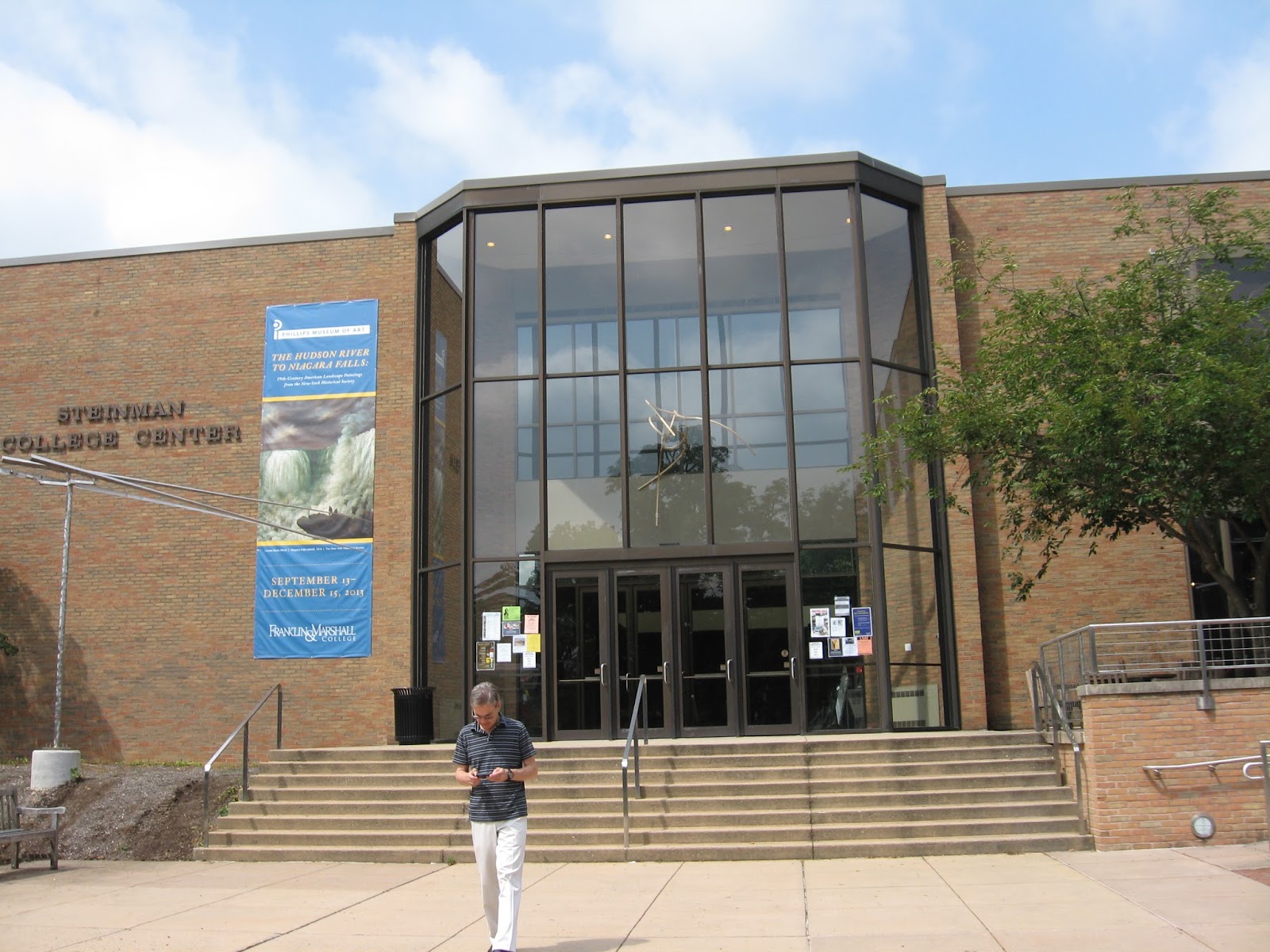
Franklin & Marshall College


The Basics - Franklin & Marshall College (F&M) is a residential college of about 2,000 undergraduates on a 125-acre campus in Lancaster, PA.


Dorm Life - At F&M, you will live with the students in your freshman seminar class in one of the five college houses. Students are interviewed for a half hour to pick a compatible freshman roommate. As a sophomore, you have the opportunity to move to suite style living. As a junior or senior, you can move to a college-affiliated apartment. Even if you don’t live in one of the five college houses as an upper-classman, you can use space in the college house you lived in as a freshman, for all four years.


Common Hour - On Thursdays from 11:30 AM – 12:30 PM, everything closes for common hour, where a talk or performance is provided with free pizza, drinks and fruit. The first common hour of the school year usually is a talk given by the college president. The college president also has open office hours when students can stop by and talk with him.


Surrounding neighborhood - F&M is in Lancaster, which has about 60,000 residents. Students can walk downtown or go by shuttle bus and take advantage of restaurants, movies, the farmer’s market and the art scene (including First Friday). The school is less than a mile from an Amtrak station.


Financial Aid - F&M is a CSS/PROFILE school that meets 100% of need; it does not provide merit aid to freshmen. If you are applying early decision, you can get an early read on your aid package.

Applying - F&M uses the Common Application, does a holistic review of your application, and recommends that you have an interview. The school is test optional; two pieces of graded writing can be used in lieu of the SAT or ACT. The school has a 36% acceptance rate with 52% of students applying Early Decision. Early Decision I has a November 15 application deadline and Early Decision II has a January 15 application deadline.


Academics - Students declare their major after the sophomore year. The most popular major is Business, Organizations and Society; Government is the second most popular major. F&M offers nine foreign languages and requires students take three semesters of a foreign language (or place out of the language).


Study Abroad – F&M has its own study abroad programs in France and in England. F&M students also participate in 200 other study abroad programs. Study abroad programs vary in length from a 6-week summer program, to a semester or a year. Students can use their financial aid package when studying abroad.


Greek Life - 35- 40% of students are in one of the seven fraternities or four sororities. Students can rush starting in the second semester of college.


Sports – The school competes in NCAA Division I wrestling and in NCAA Division III for other sports. Club and intramural sports are popular.


Who would be happy at F&M? - The admissions representative felt that the type of student who would be most happy at F&M is one who wants to be involved in academics, extracurricular activities and the community.


What is your experience with F&M?

Tuesday, August 6, 2013

The Insider’s Guide to the College Interview


Admissions personnel, alumni, or students may interview prospective students as part of the admissions process.  The interview lets the college get to know the prospective student as a person, not just as a name with list of grades and scores.  As much as the interview is a tool for the college to see if they want an applicant and to woo them, it is an opportunity for an applicant to learn more about the college and see if they want to attend.  Two alumni interviewers provided the following advice.

George Gawrys, a former alumni interviewer for MIT recommends:
1.      Be ready to describe why you’d be a good choice for the school (what will you contribute to the student body besides your brains, grades, and SAT scores).
2.      Be ready to talk about what you’ll major in and why, even if you are not sure.
3.      Act like the school is your first choice, even if it’s not.
4.      Have important questions ready to ask about the school and its locale.  Do some research on the school and familiarize yourself with the departments, reputation, and even some of the faculty.
5.      Don’t be shy, but don’t be arrogant either.

MIT
Curt Schmidt, an alumni interviewer for Lehigh University, indicates that Lehigh interviews are considered informational and that most students from central New Jersey interview on-campus with a representative of the Admissions Department, because of Lehigh’s close proximity.  An interview with a local Lehigh alum can be arranged, upon request.  Curt shared the following advice for those interested in interviewing with an alum:

1.      Request an interview with an alum that has a similar major or career to the one you are considering.  Alumni can provide insight into the college placement and career counseling available.
2.      Stay relaxed and confident, and answer honestly. 
3.      Don’t be afraid to say, “I don’t know.  I will have to think about that.”

Lehigh
If you accomplish the following four things at the admissions interview, it is likely to be a success:
1.      Demonstrate good interpersonal skills.
2.      Show that you are knowledgeable and strongly interested in attending the college.
3.      Share information about yourself and your interests that make you desirable to the college.
4.      Get answers to important questions you have about the college.

Please chime in and share your insights.  If you interview prospective students for a college, what advice would you give?  If you recently had a college interview, what do you wish someone had told you, before the interview?


Tuesday, July 16, 2013

Academic term types


Academic term types vary from college to college and include semester, trimester, quarter, 4-1-4, 4-4-1, and block plan, also known as one course at a time. A brief description of these academic term types can be found towards the end of the “Academic term” entry in Wikipedia under the heading “Collegiate calendars.”


Would you be more likely to attend or avoid a college because of the schedule of academic terms?

Which of these schedule of academic terms appeals most to you and why?

What do you see as the pros and cons of these schedules?

Thursday, June 20, 2013

Ten College Essay Tips


Here are ten college application essay tips shared by the young adult author, Hillary Frank, at the New Jersey Association for College Admission Counseling annual conference:


1. If you are having trouble with the essay, consider:

  • Telling your story to a friend

  • Recording yourself telling the story

  • Writing a letter about the story

  • Reading the draft out loud.

2. Don’t tell me what you think I want to hear.

3. Don’t be boring. Use compelling visual details.

4. Tell me something I’ve never heard before.

5. Use your authentic voice.

6. Use your speaking, rather than your writing voice.

7. Write a first sentence that:

  • Piques the reader’s interest

  • Is worded artfully

  • Provides a memorable visual image or point of view.

8. Uses similes never heard before.

9. Make characters complex.

10. Show surprising personal growth.

What tips would you share about writing the college application essay?

Monday, June 10, 2013

Gap Year Basics


A gap year is a structured period of time when students take a break from formal education to explore areas of interest in the United States and/or abroad via one or more planned activities like travel, foreign language immersion, internships, volunteer work, and/or work. For many, this is a once in a lifetime opportunity. Often students postpone starting college for a year and the gap year is taken between high school graduation and the deferred start of college.
 
Some gap year benefits – After a well planned gap year, students typically:
  •  Have pursued and clarified their interests through real-world experiences. They are therefore less likely to change majors in college and more likely to finish their Bachelor’s degree in four years
  • Gain insight about themselves and their goals.
  • Are more mature, focused, independent and self-confident.
 
What kind of student might benefit from a gap year? – Many different kinds of students might benefit from a gap year, including students:
  •  With multiple interests
  • Unsure whether they want to pursue a particular major/career
  • Without a clear academic focus
  • Who are burned-out after high school.
 
How much will a gap year cost? Gap year programs range from free to thousands of dollars. In free programs, students often get room and board, in exchange for work.
 
Before taking a gap year – Here are six steps to take before taking a gap year: 
  1. Apply to college. 
  2. Get accepted to college and defer your college enrollment.
  3. Decide on the interests you want to pursue during the gap year and your budget.
  4. Identify gap year programs within your budget, that let you explore your interests.
  5. Check the quality and safety of those programs.
  6. Select and register for the gap year programs, you wish to pursue.
Pay it forward - What is your experience with a gap year?  How did it change you? Who would you recommend it to? 
 
References – Here are three on-line gap year references that may be helpful:

Monday, May 13, 2013

University of Delaware, Newark, Delaware

Inside the student union building

Plenty of green spaces and brick buildings

Admissions building
Basics - The University of Delaware in Newark, Delaware is a Tier 1 research university. It has 16,000 undergraduates and 3400 graduate students. There are students from all 50 states and 100 countries. 35% of these students are from Delaware. New Jersey sends the most students, after Delaware. Housing is guaranteed all four years for students who enter as freshmen. The campus is physically large, covering 1,241 acres.


Academics - Class sizes vary with 62% of classes having 25 or fewer students, 24% having 26 – 50 students, 10% having 51- 100 students, and 4% having more than 100 students. In the 7 colleges, there are over 145 majors and 100 minors.

450 students in the freshman class, including my tour guide who hailed from Georgia, are part of the Honors program. Students applying for the Honors program need to write an additional essay as part of their application. These students take many honors classes, which are capped at 25 students, and have honors housing.

The University of Delaware has had study abroad since 1923. The school is on a 4-1-4 calendar so students can study abroad for a full semester or during the optional 5-week winter session.

Summer scholars have an opportunity to do research over the summer while receiving a $3,000 stipend.

Extracurricular activities - There are over 300 student organizations; Division I athletics, including football; 32 club teams, hundreds of intramural teams, and Greek life, with 20% of students going Greek. The main drag outside of campus is full of restaurants, stores, and students.

What’s New - There are a number of construction projects on campus that are near completion. The following are slated to open in the Fall: a new freshman residence hall that will house 767 students, a 194,000-square-foot Interdisciplinary Science and Engineering Lab, and a renovated and largely-expanded sports building.

Applications and Financial Aid - The admissions office looks at the applications holistically. They evaluate each student’s core classes, look at the SAT (all three sections) and/or the ACT (which they superscore). They consider how well prepared students are for their major (i.e., did you take honors or AP classes in the area of your planned major). The University of Delaware uses the Common Application. They are looking for recommendations from your high school counselor and one teacher. They offer optional, evaluative interviews to high school students between June of the junior year and Thanksgiving of the senior year of high school. The University of Delaware offers both need-based and merit aid, with merit aid ranging from $1000 up to a full ride.

If you are a student at the University of Delaware, what do you like most and least about the school?

Thursday, May 9, 2013

Ursinus College, Collegeville, PA


Theatre


Bomberger Hall houses music rooms
  
Art Museum


Campus Map
Campus - Ursinus College is a small liberal arts college of 1750 students, 28 miles northwest of Philly. The school sits on 170 acres, with plenty of green space, lots of outdoor sculpture, and buildings with a variety of architecture styles in the small town of Collegeville. The school houses an art museum and two theatres.


Academics – All freshmen participate in the two-semester seminar where they read and discuss texts to help answer questions like: What does it mean to be human? How should we live our lives?


In addition, every student must participate in at least one of the following: independent research, a creative project, study abroad, internship, or student teaching.

Most classes, with the exception of some introductory classes (e.g., Introductory Psychology), are small.  80% of classes have fewer than 20 students. No classes are taught by teaching assistants. Freshmen meet with their advisor weekly in person, by phone, or by email. The school gives every freshman a laptop.

The school offers 27 majors and 51 minors. Double majoring is popular.  The school has some unusual majors for a small liberal arts college, like neuroscience and East Asian studies.
About eighty students do summer research on campus and receive free room and board, as well as a stipend.

Housing – Housing is guaranteed all four years and 97% of students live on campus. In addition to the usual dorms, there is themed housing in six or seven Victorian houses across the street from campus for upper classmen who apply. The themes change yearly and are selected by the student body.

Extracurricular activities – One third of the students participate in a Division III sports team, with football and women’s field hockey being most popular. Club and intramural sports are also popular.

The school has Greek life, but no Greek housing.  There are more than 80 clubs, organizations and interest groups, as well as many opportunities for volunteering. The Ursinus Center for Advocacy, Responsibility and Engagement is the focal point for community service and civic engagement at Ursinus.

There is a large shopping mall, with a movie theatre a short drive away.

Transportation – There is a city bus that takes students to a train station, where they can catch a train to Philly.  Freshmen are not allowed to have cars on campus.

Financial aid – In addition to need-based aid, there are scholarships and academic awards of up to $30,000 a year, including a creative writing award.

Tour Guide – My tour guide was a well-spoken, enthusiastic senior, who was going to med school in the fall. He had participated in summer research, which led to a presentation at a conference, and had participated in an intramural sport while at Ursinus.

Have you attended or visited Ursinus College recently?  If so, what was your experience?