Search This Blog

Monday, September 8, 2014

Saint Joseph's University


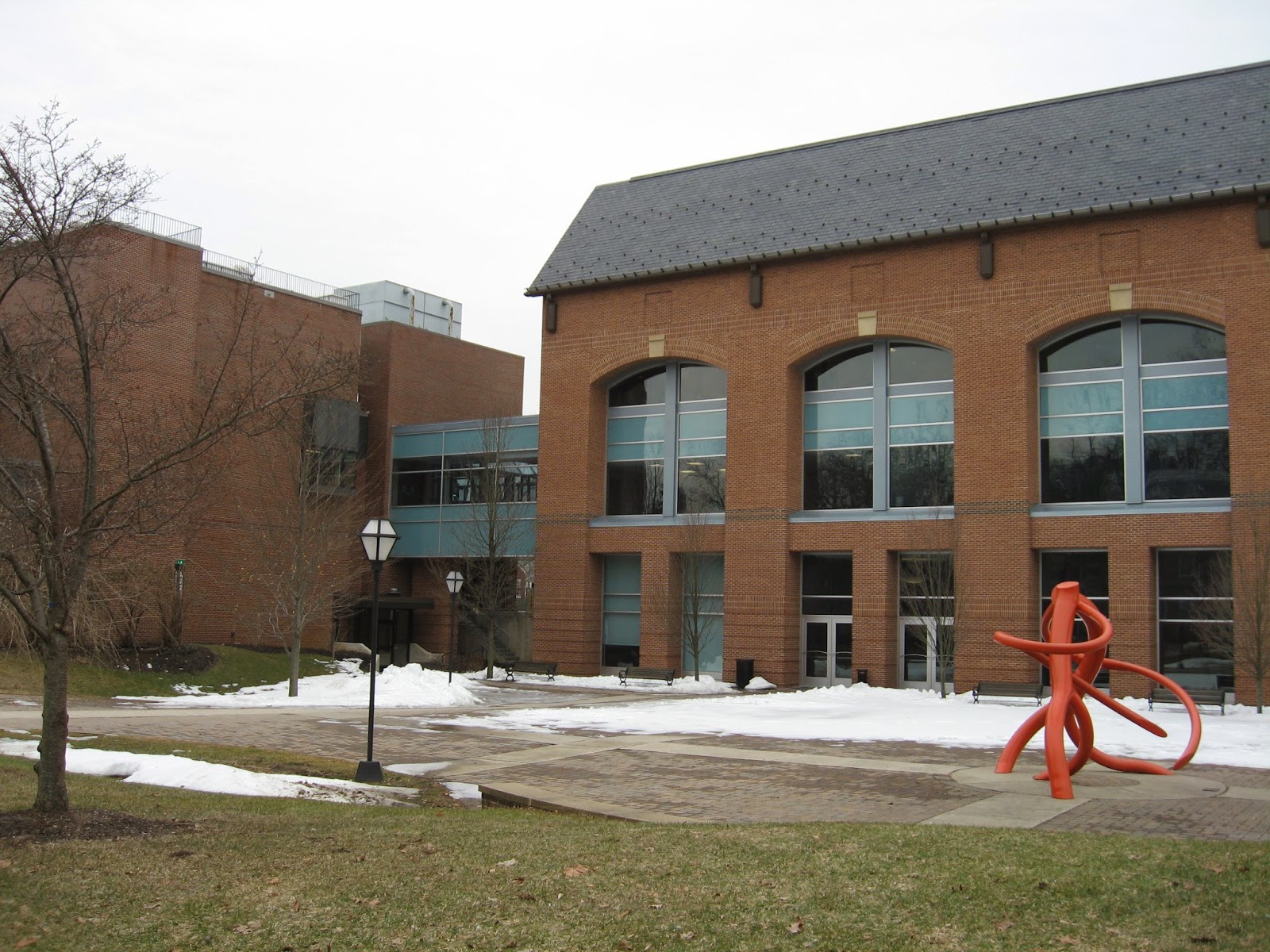
Last week, I visited St. Joseph’s University (SJU), a co-ed Jesuit university with about 4500 undergrads in a suburban setting on the western edge of Philadelphia.  At SJU you will see flags and signs that say magis.  Magis is a Jesuit principle that inspires students to think broader, dig deeper, and work harder.

Academics: The university has two colleges: a college of business and a college of arts and sciences, with about half of the students in each.  The typical class size is 23 with the maximum class size capped at 35.  Students can double major or major and minor across the two schools.

The business school requires that students have at least one internship; two or three internships are typical.  Students in the college of arts and sciences have the opportunity to do research over the summer after their Sophomore or Junior year, while getting paid $3,000.

Two unusual majors that SJU offers are Food Marketing and Autism Studies.  The Food Marketing can be taken as a 4-year program or as a 5-year co-op program.  Students in the co-op program typically get paid $17-$24 per hour for their co-op work while gaining valuable experience in their field of study.

The most popular countries for study abroad are Italy, Spain, Ireland, and Australia.  Study abroad is popular as a semester in the Junior year, a summer program, a spring break program or a winter break program

All students must take two religion courses. 

My tour guide Dan, was double-majoring in Economics and Political Science.

Extra-curricular activities: The college motto is “men and women with and for others” and 90% of students will do some type of community service while a student at SJU.  For example, during Spring Break, 500 students go to Appalachia and build homes with Habitat for Humanity. 

The Division I athletics also bring out the school spirit, especially the St. Joe's vs. Villanova basketball games.  Students can get basketball season tickets for just $80.  My tour guide recommended that visiting high school students attend a basketball game, if possible, to get a sense of the Hawks school spirit.

There are over one hundred clubs and organizations, including Greek life.

SJU runs two bus routes which take students to the train station, stores, and popular off-campus housing locations.

Admissions: St. Joe’s accepts the Common Application. They have both Early Action and regular admission.   The mid-50% of SAT scores is 1100 – 1280 (Critical Reading and Math).  The school is test-optional.  Admissions to SJU is not by major.  There is merit and need-based aid.  All students receive some sort of financial assistance.


What is your experience with SJU?

Wednesday, August 27, 2014

If Your Life Is Not A Bowl of Cherries

So you want to go to college, but there has been a significant problem during your high school years.  Perhaps you have been suspended, been arrested, have abused drugs or alcohol, or have suffered from a mental illness.

You might wonder what your options are, so first ask yourself these three questions:
  1. Have I healed from the problem? 
  2. Do I want to go to college?
  3.  Am I ready to start college with the rest of my high school graduating class?

If you answered no to one or more of these questions, you may need professional help to recover from the problem and/or you may want to work or take a gap year (or more) before pursuing further education.
  
If you answered yes to all three of these questions, I recommend that you write an extra essay, a special circumstances essay, as part of your college application.  This essay should be focused on your recovery, not your problem, and should describe how the problem led to who you are today.  In this essay, you will let the college know what the reason for your suspension, arrest, drop in grades, and/or missed semester was.  You will need to take full responsibility for what happened, explain how you have changed, and what you have learned from your decisions.  

Tuesday, August 5, 2014

The Changing SAT and ACT Landscape


Here are the highlights of a recent HECA webinar on testing by Jed Applerouth, founder of Applerouth Tutoring Services

SAT changes: The SAT is morphing into an ACT.  It has been changing from an aptitude test to an achievement test.  In 2016, it will undergo a major shift.  It will:
  • Drop sentence completion
  • Add more difficult math
  • Eliminate calculator use for one math section
  • Include grammar questions in the context of paragraphs
  • Add science tables, charts and graphs to verbal and math sections
  • Include evidence-based essays
  • Eliminate questions that are not aligned with the Common Core standards
  • Allow more time per question.

The math will include new topics including trigonometry, radians, equations of a circle, and congruence theorems.  There will be less geometry and there will be more algebra, requiring a deeper understanding of equations. 

Students will have twice as much time for the new essay.  “[The] essay should not explain whether you agree with [the author’s] claims, but rather explain how [the author] builds an argument to persuade his audience.”

The current SAT allows more time per question than the ACT.  The new SAT will allow even more time, which will be a plus for students with slower processing speeds.

ACT changes:  The ACT changes are subtler and include:

  • Essay changes - Students will be asked to analyze a complex issue, after being provided several perspectives.
  • Extra scores/reporting – There will be four new college readiness indicators: a STEM score of math and science; an English Language Arts score of English, Reading and Writing; a Progress Towards Career Readiness score; and a Text Complexity Progress indicator.
  • Digital assessments – Computer-based tests will be introduced in some districts and states in 2015 and will be introduced more widely in 2016.
  • Reading changes – Students will be asked to compare and contrast two reading passages (as has been done in the SAT).
  • Optional constructed response subject test. – Optional 30-minute subject tests in reading, math and science, that assess whether students can justify, explain and use evidence to support claims, will be added.

Timeline: The timeline of SAT and ACT changes are as follows:

  • December 2014 – Practice PSAT released
  • March 2015 – Practice SATs released with College Board book to follow
  • Spring/Fall 2015 – Digital ACT and ACT changes
  • October 2015 – New PSAT for Class of 2017 and 2018
  • January 2016 – Final old SAT
  • March 2016 – New SAT released and first digital SAT.

The Class of 2017 (rising Sophomores) will be able to take either the old SAT or the new SAT or both.

Are you looking forward to these changes?   

Friday, June 20, 2014

Visual and Performing Arts


Here are some important points made by Beth Dombkowski of Rowan University and Laura Arbogast of Fashion Institute of Technology (FIT) on Visual and Performing Arts from the June NJACAC Conference:

  • Look at the college’s accreditation.  You would like to see accreditation by NASM for Music, NASAD for Art and Design, NAST for Theatre, and NASD for Dance.
  • Consider the school’s location.  Being in or near a large city is a major plus (e.g., it will provide you more opportunities for art internships).
  • Consider whether you would prefer a discipline-specific school (e.g., FIT) vs. a Larger University (e.g., Rowan)
  • Consider whether you would prefer a Traditional program (e.g., all Visual Arts students start by taking the same basic art courses) or a Direct Entry program (e.g., need to know what type of art you are most interested in and begin courses in that area of art immediately).
  • Attend a Performing Arts and Visual Arts Fair – These are college fairs that focus on schools with strong programs in performing and visual arts.  There are upcoming fairs in our area in the Fall including:
    • Philadelphia, Monday, 10/6
    • New York City, Tuesday, 10/7
  • Some good questions to ask the school are:
    • What are students producing?
    • Who will teach me?
    • What are support services?
    • What performance opportunities are available to me as an undergraduate?
    • What internship or employment opportunities are available to me?
    • Can I perform professionally outside of school while I am an undergraduate?
  • Tips on creating an art portfolios:
    • Different colleges have different portfolio requirements.  Review the requirements for the colleges you are considering.
    • Summer is a good time to work on your portfolio.
    • Go to a National Portfolio Day to get feedback on your portfolio from the colleges you are planning to apply to.  Typically high school juniors and seniors attend National Portfolio Days.   Upcoming 2014 dates in our area include:
      • Philadelphia – Sunday, 11/9
      • SUNY Purchase – Saturday 11/15
      • New York City – Sunday, 11/16
  • Tips on music auditions and placement exams:
    • Colleges generally list what is required for their music audition on their Web page.  Make sure you can do and are prepared to do all the parts of the audition.  This varies from college to college.
    • Colleges often require placement exams.  For example at Rowan, all music majors are required to take placement exams in Theory, playing the piano, and sight singing.
  • Theater major tips:
    • Bring a resume listing your theater performance experience to your audition
    • Before your audition, rehearse you piece in front of a live audience.
  • The job outlook for the visual and performing arts in the Northeast shows growth in:
    • Film & video editors (19%)
    • Interior design (14%)
    • Art director (11.7%)
    • Fine artists (10.3%)
    • Set and exhibit design (9%)
    • Photographer (7%)

Wednesday, May 14, 2014

DeSales University


 My tour guide at DeSales University was a junior studying to be a Physician Assistant.  In addition to working for Admissions as a tour guide, she worked in Catering on campus, was involved in Character U serving as a peer mentor for freshmen, and loved to do Zumba.  Some key campus buildings include Dooling Hall (classrooms), University Hall (dining hall, conference center, campus store, radio-station), Gambet Center (newest classroom building for business, physician assistant, and nursing), Hurd Science Center (science classrooms and labs), Trexler Library, and McShea Student Center (open 24 hours for student events and entertainment).

DeSales University is a co-ed Catholic University with about 1600 undergraduate day students in Center Valley, PA which was founded in 1964.  It is about 7 miles from Allentown and Bethlehem, PA.  Around 85% of students return for their sophomore year and 70% graduate in six years.  The most popular majors are health-related (e.g., Nursing, Physician Assistant, Biology), business, and visual and performing arts.  DeSales hosts the Pennsylvania Shakespeare Festival. 

Housing is guarantees all 4 years and about 80% of students live on campus.  Housing is all single-sex.  One nice feature of the freshmen dorm we saw was that each room had a sink and every two rooms shared a shower (i.e., 1 shower for 4 students).  There are 16 Division III sports, with basketball and soccer being the biggest spectator sports.  There are no fraternities or sororities.  


Friday, April 4, 2014

University of South Carolina

On 3/26/14, Kate Balboni, the Regional Admissions Representative from the University of South Carolina for Northern New Jersey, spoke to a group of high school guidance counselors and independent college admissions consultants in Bridgewater, New Jersey.  Here are some highlights from her presentation.

The University of South Carolina is in the state capital, Columbia with a population of around 800,000.  There are about 23,000 undergraduates.  A large percent of the University’s students are from outside of South Carolina.  New Jersey is the number five state sending students to the University.  The University is 12 hours by car from NJ. There are direct flights from Newark to Columbia, or connecting flights through Charlotte.  The mid-50% SAT scores (Critical reading and Math) for Freshmen are 1120-1280.

There were 591 applicants from Northern NJ this year with 277 admitted (47%) and 87 enrolling.  Of the 87 students, 11 are in the Honors Program and 28 are in the Capstone Scholars program.  Fifty-five percent received merit aid.

There are 95 majors.  The school is known for its international business, its hotel, restaurant and tourism management, and its risk management and insurance majors.  The university has the largest sport and entertainment major in the country.  Other popular majors are nursing, psychology, biology, biomedical engineering, marine science, mechanical engineering, exercise science, and the 6-year pharmacy program. 

The Honors College has its own academic building and dorms.  Honors students get first pick at research opportunities, do a senior thesis, and are eligible for 6-year law and 6-year Pharmacy program.  They can take their Gen Ed requirements at the Honors College.   The mid-50% SAT scores (Critical Reading and Math) for the Honors program are 1390-1470.

The Capstone Scholars program is a two-year enhancement program where students engage in one activity in Leadership, Community Service, Academics, and Social. These include special classes, their own residence hall, and opportunities to compete for travel grants for the May semester or summer study abroad.  The mid-50% SAT scores (Critical Reading and Math) for the Capstone Scholars program is 1290-1360.

Cost of Attendance for out-of-state students is $38.4K per year.  There are out-of-state scholarships, some of which are substantial.  The top out-of-state scholarship is the McNair Scholars, worth $32,000 a year.  It is awarded to 20 out-of-state students.    The Horseshoe Scholars Award is worth $28,000 a year and is awarded to another 20 out-of-state students.  Last year McNair and Horseshoe Scholars had an average SAT score of 1507 (out of 1600).  There are other out-of-state merit scholarships valued between $8,000 and $23,000 a year. 

The school has over 400 clubs.  There are 17 Division I teams.  There are free tickets for students to watch the Division I sports. Football is the big spectator sport in the Fall and Baseball is the big spectator sport in the Spring.  

Twenty percent of student go Greek.  Greek students attending the Football games get dressed up (i.e., guys wear jackets and ties and gals wear heels and pearls).  

If you are a student looking for a large State University the South, with Greek life, and strong Division I sports, the University of South Carolina might be for you.  If you are a very strong student academically, the Honors or Capstone Scholars program along with the merit aid for out-of-state students might seal the deal for you!

Wednesday, March 19, 2014

Moravian College (Bethlehem, PA)

Campus Map


Last Wednesday, I toured Moravian College with a Sophomore majoring in Environmental Policy and Economics, who attended a small Catholic High School in Philadelphia.  In addition to being a Tour Guide, she was the Treasurer of the Sustainability Club and she liked going to the free weekly movies with her roommate.


Here are some things she said that made Moravian special:
  • Friendly students
  • Small classes
  • Strength in the Sciences and in Education
  • Free tutoring by students
  • A May term that students can use for study abroad
  • A 10-week summer research program, called SOAR, that pays students $3000, provides free housing on-campus, and a travel allowance.
  • Living and Learning suite style housing is available for Freshmen taking the same freshman seminar
  • Starting in the Fall 2014, each student will be provided with a MacBook Pro laptop and an iPad.
  • A one-week pre-freshman orientation.  Students can come to campus a week early, live on campus while working together on a volunteer activity in the community.  My tour guide volunteered at a local YMCA for the week.
  • Students can develop their own major.
 I toured the Main Street campus, also known as the North Campus.  This is the larger of the two campuses.  Both campuses have classes, house students, and have all-you-can-eat dining, as well as grab-and-go dining.  The two campuses are about a half-mile apart and there is a free shuttle bus that runs between them.  The academic focus of the South campus is Music and the Arts.  Music students give music recitals throughout the year, which are open to the student body.

The North Campus is a compact campus with a mix of old and new buildings.  They have dorms that are coed by floor, all female dorms and all male dorms.  Popular spectator sports are Softball, Baseball, Soccer and Women’s basketball.  "Impact" arranges for activities like movies, trips, and bingo. About 20% of the school is involved in Greek life.
Greek Life
Beautiful old  buildings
Mixed with newer buildings
Impact Bulletin Board with Upcoming Activities