Search This Blog

Thursday, June 27, 2019

Lasell College


In the spring, Jessica Snover of Lasell College admissions spoke at a Higher Education Consultants Association meeting in NJ.  Lasell College is a private college offering professionally-oriented degrees, located on 53 acres in Newton, Massachusetts, a suburb of Boston. Lasell has 1700 undergrads with 84% of them living on campus.

Academics – Lasell classes are small with 0% having more than 50 students.

Lasell Works is a relatively new program, with 60 freshmen this school year. It is a career-focused, cost-saving program; tuition is reduced each year. Freshmen spend their first year on campus. As sophomores, they live off-campus, take all their classes on-line and work part-time. In their junior and senior year they can live on or off-campus and complete internships and their course work.

NJ students seem drawn to Lasell’s fashion and sports management majors.

Education majors will find that Lasell has a pre-K, Kindergarten and first grade on campus. Students graduate with a Massachusetts education license (which is recognized by NJ).

Biology and Applied Forensic Science are new majors.

All majors, with the exception of Education, can be completed in three years. There are also 5 year Bachelors/Masters program.

In the Honors program, students take four Honors classes and four Honors Components (projects). Students must maintain a 3.5 college GPA to remain in the Honors Program.

Admissions – The application review is holistic. Lasell is test optional except for Education majors who need a minimum of 1070 on the SAT. Lasell students had an average high school GPA of 3.0. Exercise Science, biology, and applied forensic science majors need a minimum GPA of 2.7.

Internships/Jobs – A lot of students intern for TJX, the parent company of TJMAX and Marshalls. New England Sports Network hires some of the Sports Communications majors. A new casino in Boston hired 30 recent graduates.

Extracurricular activities – Lasell is an NCAA Division III school with 17 varsity sports. There are 75 student clubs. Times are blocked out on Tuesdays and Thursdays for club meetings. There is no Greek life. Lasell is a half mile from the T station to Boston.

Support Services – The school has services for learning differences, as well as students on the spectrum. Professional and peer tutors are available.

Merit Aid – Students can receive up to $32K in merit aid based on a formula.

Crossover colleges include Endicott, Curry, and Merrimack.


Wednesday, May 29, 2019

Siena College


General - Siena College is a Catholic college of about 3100 undergraduates in Loudonville, New York, a suburb of Albany. Most of the buildings are low-rise brick buildings.


An unusual architectural feature is the Grotto (pictured below), modeled after the Lourdes shrine.


Student Body - Most students come from New York City or upstate New York.

Academics - Classes are small with the maximum class size capped at 35 students and no teaching assistants. About a dozen friars teach or advise clubs.

About 39% of students are in the AACSB-accredited business where students can become Bloomberg-certified and have an opportunity to invest a portion of the school’s endowment.

The school has a small, relatively-new nursing program with opportunities to be in a hospital setting starting in the sophomore year. 


There is a BA/MD program with Albany Medical College.

Extracurricular activities – Siena is a NCAA Division I school with men’s basketball and hockey being the most popular spectator sports.


There are over 125 organization, but if you are interested in starting a new club, you can.


While Siena does not have traditional Greek life, it does have one coed national-base business fraternity.

There are a lot of volunteer opportunities at Siena, including a Bonner Service Leaders program.

Friday, March 22, 2019

Florida State University (FSU)


Florida State University (FSU) is a Florida public university with about 33K undergraduate students in the state capital Tallahassee, a small city in the northern part of the state.

Academics – Top majors at FSU are biology, business, engineering, psychology and clinical professions. The university has a 94% retention rate and a 90% six-year graduation rate. 

The engineering program is a joint institution serving both FSU and Florida Agricultural and Mechanical University (FAMU).

Studying abroad – Over 2000 students study abroad each year in one of 20 countries. See “Financial” for a special deal for out-of-state students who study abroad for their freshman year.

Extracurricular Activities – FSU is a NCAA Division 1 school with a football team. There are no fraternities or sororities. One unusual extracurricular activity is the FSU Flying High Circus.


Housing – First year students live in a suite or an apartment style building. There are Living and Learning Communities for shared interests (e.g., social justice), shared majors (e.g., music), and shared career paths (e.g., health professions).


Financial – The in-state cost for tuition and fees, housing, meal plan, and books and supplies is about $18.3K per year, while the out-of-state cost for the same items is about $33.5K per year.

One unusual draw to FSU is that out-of-state students are eligible for in-state tuition for the remainder of their undergraduate degree if they spend their first year abroad in an FSU study center in London, England; Florence, Italy; Panama City, Panama; or Valencia, Spain, typically saving about $36K.

Applying – Students who apply by November 1 have a decision by January 31 and priority consideration for merit aid.

The student admitted profile for the Fall mid-50% is a core academic GPA of 4.1-4.5, and an SAT of 1290 – 1400 or an ACT of 28 – 32. 

The student admitted profile for the Summer mid-50% is a little lower: core academic GPA of 3.8 – 4.3, SAT of 1210 – 1310 or an ACT of 25 – 29.


Tuesday, February 12, 2019

Tulane University


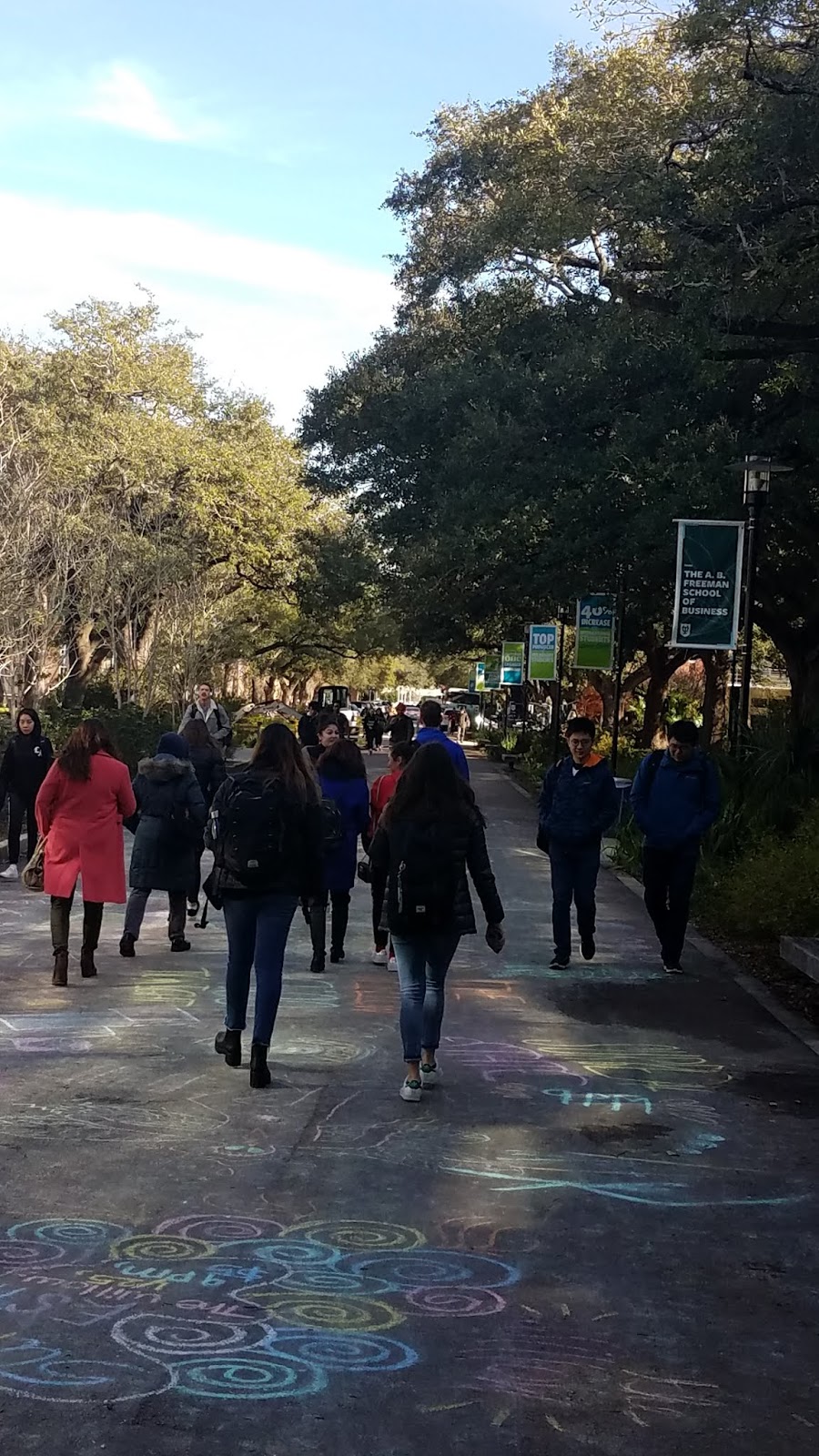
Tulane University is a private, residential, research university in New Orleans, Louisiana with about 6800 full-time undergraduates from all over the country and the world. The location in a big city, known for great food, night life, jazz music and interesting architecture is big draw, especially since the school has a campus. A big campus tradition is throwing your Mardi Gras beads on this tree in the academic quad.


One distinguishing factor is Tulane’s focus on community service. Tulane has public service graduation requirements including:
·    One service learning course no later than the fifth semester 

A second distinguishing factor is that students do not apply to a particular school or major within Tulane University and they can take classes in any of Tulane’s colleges.


According to Tulane's website "applications to Tulane have increased more than 65 percent over the past five years, with 41,365 applications arriving this year. The university's selectivity rate, the number of students who apply versus the number of students who are accepted, also improved to just over 13 percent – matching or surpassing some of the nation’s top schools."

Wednesday, January 2, 2019

College of Charleston


General - The College of Charleston is a public liberal arts and sciences college with about ten thousand undergrads in beautiful, downtown Charleston, South Carolina. The college was founded in 1770 and it has a combination of old and new buildings, including a new science center which opened this fall. Computer Science is in a separate location about a 10 to 15 minute walk near Charleston start-up companies.
Academics - Students choose from among over 130 majors and the average class size is 26. No classes are taught by teaching assistants. The fastest growing majors are public health, marketing, finance, arts management and exercise science. Students can double major or major and minor. About half the students study abroad in one of 85 locations.  Pre-med students get opportunities at the Medical University of South Carolina which is also in Charleston. College of Charleston has an Honors College.
Greek Life - College of Charleston students can rush at the beginning of the freshman year. About 20% of undergrads are involved with Greek life. Greek housing is limited to officers plus a few more.
Sports - There are 19 Division I sports teams. Basketball is popular. The school excels in sailing. Equestrian is available. The sports complex is a drive away.
Clubs and more – There are over 280 clubs and organizations. There are three beaches with a 25-minute drive and three professional sports teams in the vicinity. Charleston is known for arts festivals like the Spoleto festival.
Tuition - Tuition for out-of-state students is $31.6 K and the average room and board is $12.2K. The Net Price Calculator includes a merit aid estimate. Your financial aid package and decision letter come together.
Housing - Freshmen living on campus are in doubles. They can be in traditional doubles with communal bathrooms down the hall (cleaned by the college) or two double rooms can share a bathroom (which the residents must clean). Freshmen who deposit by May 1 can live on campus. Only 20% of upper classmen live on campus.
Dining – College of Charleston has three dining halls, two of which are all-you-can eat. One of the all-you-can-eat dining halls has a station without the most common six food allergens. The third dining hall has vegetarian, vegan and kosher food.
Applying – For out-of-state students, the mid-50% of SAT scores are 1130 – 1290 and the mid-50% of ACT scores are 24 – 29. The school has Early Decision (11/1), Early Action (12/1) and Regular (2/15) deadlines. Students interested in the Honors College should apply by 12/1.

Wednesday, October 24, 2018

What's New At Six Northeast Colleges

Rider


Last week I attended a NJACAC panel discussion with admissions representatives from six colleges: Rutgers, Villanova, NYU, Yale, TCNJ and Rider. Each representative shared news from their campus.

Rutgers –  
  1. Rutgers had a record-breaking class of 7033 freshmen this fall with an average SAT score of 1300 and an average GPA of 3.7.  The top 100 students in the freshman class had an SAT score above 1440. 
  2. This spring marks the first graduating class of the Rutgers Honors College. The average SAT score in the Honors College was 1480.
  3. In 2020, Rutgers will open a one-stop building to house the registrar, bursar and financial aid offices.
  4. A new engineering building and a new chemical/chemical biology building opened this year. A new arts building will open on 2019.
  5. There will be $10 million dollars in new engineering scholarships.


Villanova – 
  1. Villanova has six new residence halls and they have upgraded the gymnasium.
  2. In January 2020 a new performing arts building will open.
  3. Fifteen students in the graduating class were awarded Fulbright scholarships.
  4. The college has a 96% retention rate (freshman to sophomore year).
  5. Villanova will host the largest student-run Special Olympics.
  6. The school’s Carnegie classification was changed to Doctoral Universities: Moderate Research Activity.


NYU –
  1. NYU is adding residence hall space.
  2. They are focusing on improving student retention by adding a new early warning system.  
  3. They just opened a one-stop building to house the registrar, bursar and financial aid offices.  
  4. NYU is adding more Saturday programs and summer programs for high school students.


Yale –
  1.  Yale had 35507 applicants for a class of 1578 students.
  2. They admitted 110 students from New Jersey from 1200 applicants.
  3. A new student center and a new science building will open in 2020.
  4. Neuroscience and data science are new majors. Neuroscience is the third most popular major.  
  5. Yale does not require the optional essay on the SAT or ACT. The SAT Subject test is not required.


TCNJ –
  1. The college president retired.
  2. TCNJ is opening a new STEM building  and renovated the Student Center.
  3. They have added a BA in Biology in addition to the current BS in Biology. They also added a Health major, are starting an Audiology major and will be adding an MBA soon.


Rider –
  1. Rider has renovated the Bart Luedeke Center, upgraded two residence halls, made improvements to the Business Building, and upgraded the Science and Technology Center. A $20 million addition to the Science and Technology Center will start in 18 months.
  2. There is a new dining service partner and the dining facility will be renovated next year.
  3. Rider has 920 freshmen with an average high school GPA of 3.35 and average test score of 1120 on the SAT or 23 on the ACT. The school offers test optional admissions for all except homeschooled students, and students who want to be considered for the Honors programs or full-tuition scholarships. To qualify for a full-tuition scholarship, students must apply Early Action, submit the scholarship essay, have a GPA of 3.5 or higher and an SAT score of 1310 or an ACT score of 28 or higher, complete an audition if one is needed for their major, and participate in an on-campus interview.
  4. A new Business Analytics major started in January 2018. The Actuarial Science major has been restarted. There is a new Technical Theatre concentration. The school added a BA in Musical Theatre; this is in addition to the very popular BFA program in Musical Theatre.


Tuesday, June 5, 2018

Rensselaer Polytechnic Institute (RPI)


RPI, established in 1864, has about 6300 undergraduate students on a 275-acre campus in Troy, NY.
Schools – RPI has 5 schools:
Architecture School

  1. Architecture – The Architecture school has two programs: a five-year B.Arch. and a B.S. in Building Science. Architecture classes are located in one building and there are less than 70 freshmen studying in the Architecture school. 
  2. Engineering – Engineering is the largest school and has about half of all undergrads in 11 majors. The first three semesters are the same for all engineering majors, so students can be undeclared engineering to start. The school encourages project-based, collaborative learning. A capstone is required for all engineers.
  3. Humanities, Arts and Social Sciences – This school houses a number of interdisciplinary majors including Cognitive Science; Electronic Media, Arts and Communication; Electronic Arts, and the most popular major at this school, Games and Simulation Arts and Sciences. The school recently started a music major (technical or performance).
  4. Business – This is the smallest school with about 50 – 55 freshmen. This is an AACSB accredited school with strength in technical entrepreneurship. The school has a business incubator.
  5. Science – This is the second largest school and it houses RPI’s largest department, Computer Science.
All majors have a 24-credit humanities requirement.
The Arch – Students must participate in the Arch. They take their first semester junior classes in the summer after their sophomore year. In the fall or spring semester of their junior year they must spend a semester doing an internship, a co-op, a research project, civic engagement or study abroad.
Research – About 700 students participate in undergraduate research each year, as early as the second semester. RPI is a leader in Alzheimer’s research.
Accelerated Programs – Students can gain a Bachelors and a Master’s degree in 5 years, with financial aid carrying into the 5th year. The Bachelors and Master's can be in different disciplines. Students apply for this opportunity when they are an RPI Junior. No GRE exam is needed.
There are also BS/MD, BS/JD, BS/MBA and BS/Ph.D. programs.
Admissions – RPI has ED I, ED II, and Regular Decision. They accept a number of different application forms, including the Common App. Students should have an A/A- average, a challenging curriculum with three years of science including Biology, Chemistry and Lab-Physics, as well as four years of math with pre-calculus (calculus recommended). Students need to submit SAT or ACT scores. RPI prefers that a STEM teacher write the academic recommendation letter. A creative portfolio is required for architecture, music and electronic arts majors and is recommended for game and simulation arts and science (GSAS) and electronic, media, arts & communications (EMAC) majors.
RPI gives credit for a 4 or 5 in AP courses and can students can receive up to 32 credits for AP courses.
Extracurricular activities – RPI has over 200 clubs and activities. The skiing/snowboarding club is the largest club with skiing/snowboarding 30 minutes from campus. It is easy to start a new club.
There is Greek life at RPI and students can “rush” at any time.
There are two NCAA Division I Ice Hockey teams, 21 NCAA Division III sports teams, as well as intramural and club sports. A multipurpose stadium seats 5000.
The student union building is fully run by students.
Student Union

Housing, Food and Transportation – Students are required to live on campus the first two years. There are freshmen-only buildings and there is themed housing (e.g., leadership housing). There are singles, doubles and triples. There is Greek housing both on and off campus.
There are four main dining halls. Students can have all-you can-eat buffet dining or use their Flex Dollars to buy food in cafes, in the Student Union, in the marketplaces or off-site.
Freshmen cannot have cars on campus. There is a free shuttle on campus, as well as a free local bus.
Financial Aid – No separate application is needed for merit aid. US Citizens, US Permanent Residents and Canadian citizens who submit the FAFSA and CSS Profile are considered for need-based aid.
Armory