Search This Blog

Wednesday, May 14, 2014

DeSales University


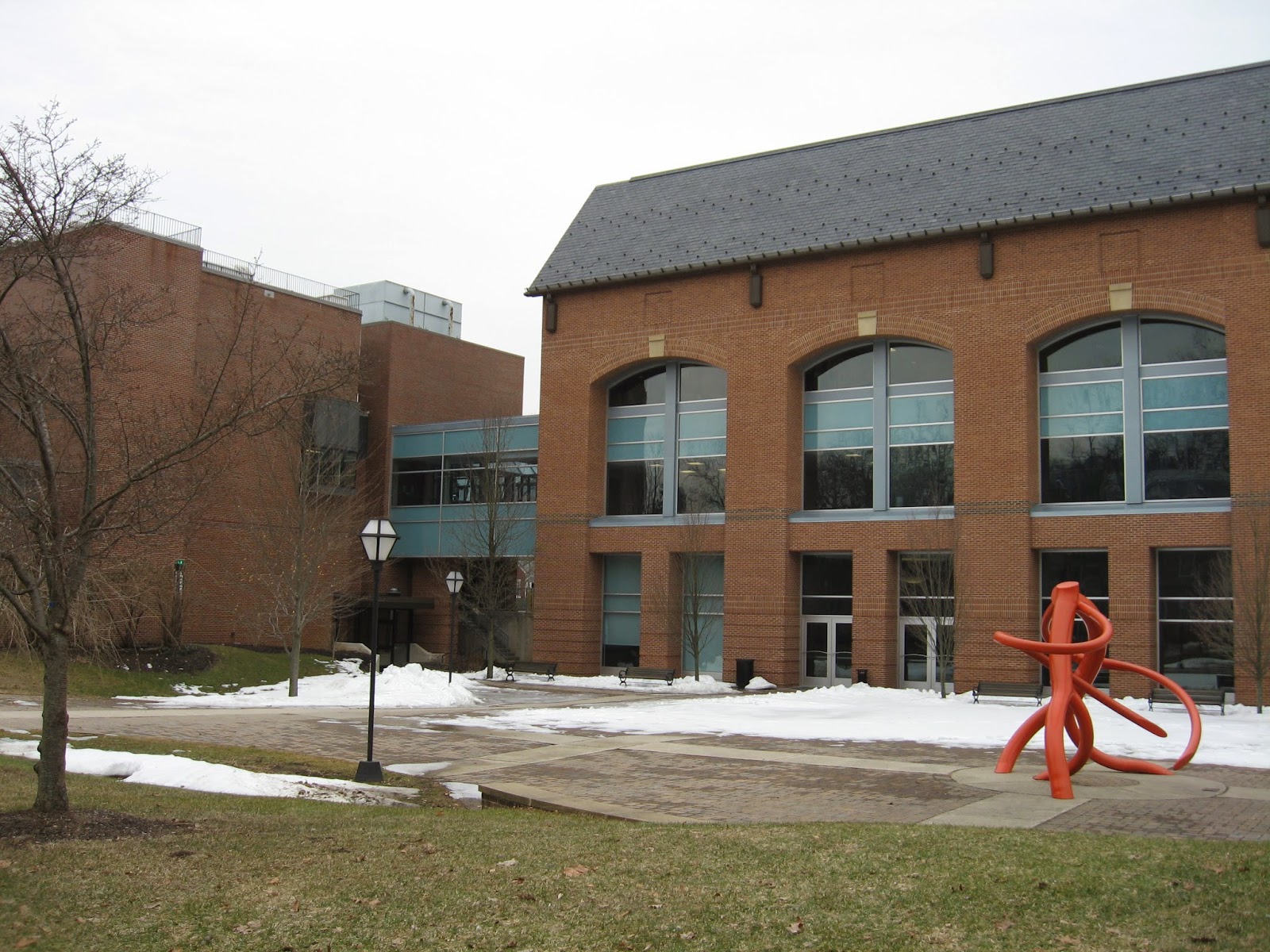
 My tour guide at DeSales University was a junior studying to be a Physician Assistant.  In addition to working for Admissions as a tour guide, she worked in Catering on campus, was involved in Character U serving as a peer mentor for freshmen, and loved to do Zumba.  Some key campus buildings include Dooling Hall (classrooms), University Hall (dining hall, conference center, campus store, radio-station), Gambet Center (newest classroom building for business, physician assistant, and nursing), Hurd Science Center (science classrooms and labs), Trexler Library, and McShea Student Center (open 24 hours for student events and entertainment).

DeSales University is a co-ed Catholic University with about 1600 undergraduate day students in Center Valley, PA which was founded in 1964.  It is about 7 miles from Allentown and Bethlehem, PA.  Around 85% of students return for their sophomore year and 70% graduate in six years.  The most popular majors are health-related (e.g., Nursing, Physician Assistant, Biology), business, and visual and performing arts.  DeSales hosts the Pennsylvania Shakespeare Festival. 

Housing is guarantees all 4 years and about 80% of students live on campus.  Housing is all single-sex.  One nice feature of the freshmen dorm we saw was that each room had a sink and every two rooms shared a shower (i.e., 1 shower for 4 students).  There are 16 Division III sports, with basketball and soccer being the biggest spectator sports.  There are no fraternities or sororities.  


Friday, April 4, 2014

University of South Carolina

On 3/26/14, Kate Balboni, the Regional Admissions Representative from the University of South Carolina for Northern New Jersey, spoke to a group of high school guidance counselors and independent college admissions consultants in Bridgewater, New Jersey.  Here are some highlights from her presentation.

The University of South Carolina is in the state capital, Columbia with a population of around 800,000.  There are about 23,000 undergraduates.  A large percent of the University’s students are from outside of South Carolina.  New Jersey is the number five state sending students to the University.  The University is 12 hours by car from NJ. There are direct flights from Newark to Columbia, or connecting flights through Charlotte.  The mid-50% SAT scores (Critical reading and Math) for Freshmen are 1120-1280.

There were 591 applicants from Northern NJ this year with 277 admitted (47%) and 87 enrolling.  Of the 87 students, 11 are in the Honors Program and 28 are in the Capstone Scholars program.  Fifty-five percent received merit aid.

There are 95 majors.  The school is known for its international business, its hotel, restaurant and tourism management, and its risk management and insurance majors.  The university has the largest sport and entertainment major in the country.  Other popular majors are nursing, psychology, biology, biomedical engineering, marine science, mechanical engineering, exercise science, and the 6-year pharmacy program. 

The Honors College has its own academic building and dorms.  Honors students get first pick at research opportunities, do a senior thesis, and are eligible for 6-year law and 6-year Pharmacy program.  They can take their Gen Ed requirements at the Honors College.   The mid-50% SAT scores (Critical Reading and Math) for the Honors program are 1390-1470.

The Capstone Scholars program is a two-year enhancement program where students engage in one activity in Leadership, Community Service, Academics, and Social. These include special classes, their own residence hall, and opportunities to compete for travel grants for the May semester or summer study abroad.  The mid-50% SAT scores (Critical Reading and Math) for the Capstone Scholars program is 1290-1360.

Cost of Attendance for out-of-state students is $38.4K per year.  There are out-of-state scholarships, some of which are substantial.  The top out-of-state scholarship is the McNair Scholars, worth $32,000 a year.  It is awarded to 20 out-of-state students.    The Horseshoe Scholars Award is worth $28,000 a year and is awarded to another 20 out-of-state students.  Last year McNair and Horseshoe Scholars had an average SAT score of 1507 (out of 1600).  There are other out-of-state merit scholarships valued between $8,000 and $23,000 a year. 

The school has over 400 clubs.  There are 17 Division I teams.  There are free tickets for students to watch the Division I sports. Football is the big spectator sport in the Fall and Baseball is the big spectator sport in the Spring.  

Twenty percent of student go Greek.  Greek students attending the Football games get dressed up (i.e., guys wear jackets and ties and gals wear heels and pearls).  

If you are a student looking for a large State University the South, with Greek life, and strong Division I sports, the University of South Carolina might be for you.  If you are a very strong student academically, the Honors or Capstone Scholars program along with the merit aid for out-of-state students might seal the deal for you!

Wednesday, March 19, 2014

Moravian College (Bethlehem, PA)

Campus Map


Last Wednesday, I toured Moravian College with a Sophomore majoring in Environmental Policy and Economics, who attended a small Catholic High School in Philadelphia.  In addition to being a Tour Guide, she was the Treasurer of the Sustainability Club and she liked going to the free weekly movies with her roommate.


Here are some things she said that made Moravian special:
  • Friendly students
  • Small classes
  • Strength in the Sciences and in Education
  • Free tutoring by students
  • A May term that students can use for study abroad
  • A 10-week summer research program, called SOAR, that pays students $3000, provides free housing on-campus, and a travel allowance.
  • Living and Learning suite style housing is available for Freshmen taking the same freshman seminar
  • Starting in the Fall 2014, each student will be provided with a MacBook Pro laptop and an iPad.
  • A one-week pre-freshman orientation.  Students can come to campus a week early, live on campus while working together on a volunteer activity in the community.  My tour guide volunteered at a local YMCA for the week.
  • Students can develop their own major.
 I toured the Main Street campus, also known as the North Campus.  This is the larger of the two campuses.  Both campuses have classes, house students, and have all-you-can-eat dining, as well as grab-and-go dining.  The two campuses are about a half-mile apart and there is a free shuttle bus that runs between them.  The academic focus of the South campus is Music and the Arts.  Music students give music recitals throughout the year, which are open to the student body.

The North Campus is a compact campus with a mix of old and new buildings.  They have dorms that are coed by floor, all female dorms and all male dorms.  Popular spectator sports are Softball, Baseball, Soccer and Women’s basketball.  "Impact" arranges for activities like movies, trips, and bingo. About 20% of the school is involved in Greek life.
Greek Life
Beautiful old  buildings
Mixed with newer buildings
Impact Bulletin Board with Upcoming Activities

Tuesday, February 11, 2014

Yale University

My visit to Yale University was out of the ordinary.  We went to the University’s Battell Chapel, on a Sunday in mid-January, for a memorial service of a family friend.  He was a Yale alum (Class of 2008) in his late 20s who clearly loved Yale and was loved by his classmates.  His friends and family came out in full force to celebrate his life.  His former Yale classmates spoke beautifully and eloquently about their friend and their time together.  They sang a cappella, as they had with him in Yale’s Society of Orpheus and Bacchus (SOBs), the second-longest-running a cappella group in the nation... or, as they prefer to put it, 20 male friends who love to sing and have fun together.  I could see and feel how these Yale students built strong, lasting friendships while working hard and playing hard at Yale.

Before the memorial service, we took the self-guided tour of Yale and visited the Yale Art Museum.  Here are some photos from our tour.


Monday, January 27, 2014

DECA Marketing Competition at Middlesex County College


Chambers Hall, Middlesex County College

In January, high school students from various Marketing Education Programs across the State of New Jersey participated in the first of their DECA (an Association of Marketing Students) competitions. The regional conference brought me to Middlesex County College, where I was a volunteer judge serving in the role of a CEO of a nationwide supermarket chain.  


College Center, Middlesex County College
Teams of two students were given a hypothetical situation that the supermarket chain was facing. They prepared for thirty minutes, and then pitched a marketing campaign for the changes to the business that they proposed.   Each team was judged and scored.  This was a wonderful opportunity for high school students to compete, get real-life experience with business people, and to have the opportunity to earn scholarship money for college. 

Wednesday, January 22, 2014

Special food needs at college

Food sustains us and provides us a social outlet.  I typically suggest that all students visiting a college try the food and watch the interaction among students in the college dining facilities.  For some students, food is more important.  Eating can be a life and death decision for a student with a severe food allergy.  Gluten can make a student with celiac disease become ill.  There are also many students who have a diet based on religious and/or moral principles.  They may only eat vegetarian, vegan, Kosher or Halal food.  So what is a student to do?

Food allergies or celiac disease.  If you are a student with a food allergy or celiac disease, consider the guidance on Choosing a School, Dorm Living, Alcohol and Epinephrine, and The Kiss Study provided by Food Allergy Research & Education.  Make sure to ask questions of the dining hall staff and to speak to students with your health problem and see how well or poorly they are doing with the college’s food services.

The food service provider Sodexho has recently started the Simple Servings station, a station containing food prepared without milk, eggs, wheat, soy, shellfish, peanuts, tree nuts, and gluten.  This should be a good match for students with a gluten-sensitivity, like those with celiac disease, as well as the most common food allergies. 

According to the Department of Justice, food allergies may constitute a disability under the ADA. That doesn't mean I haven’t heard of cases where a student transfers after a year at a college because they have ended up in the hospital emergency room several times because of a severe allergic reaction to food from the college dining hall. 
  
Vegetarians and vegans.  If you are a vegetarian or vegan student, check out what food choices will you have on campus.  Check if vegetarian and vegan foods are clearly marked in the dining facilities.  There are often vegetarian or vegan food stations and occasionally, a vegetarian or vegan dining hall, like State University of New York Purchase's all-vegetarian eating facility, Terra Ve.

Terra Ve, Vegetarian Dining Hall at SUNY Purchase


Kosher or Halal food.  If you are looking for Kosher or Halal food, here are some questions you might have.
  • Is the food available and acceptable to you?
  • Is it fresh food or just “frozen” dinners, which you can reheat? 
  • Is the food part of the normal meal plan or will you have to spend extra for a special meal plan?
  • Where on campus is the food available?
  • Is there special food available during Passover or Ramadan? 
The Hillel College guide and the Heart to Heart’s Map of Kosher Food on Campus are great starting places for students looking for Kosher dining on campus.  Since Kosher dining on campus is often both Kosher and Halal certified, this may also be a good starting place for Muslim students wanting Halal food.  Muslim students may also want to check with the Muslim student organizations on campus.  

What is your experience with special food needs at college?

Wednesday, January 15, 2014

Johnson and Wales University (JWU) - Part II


In January 2014, I visited the Johnson and Wales University in Providence, Rhode Island, which is celebrating its 100th anniversary.  The university has two campuses in Providence: Harborside, with a view of the water and Downcity, in downtown Providence.  Both campuses have housing, dining, and sports facilities and there is free bus transportation between the campuses.  My tour guide Rain lived in campus housing at the Downcity campus, while attending class in the Harborside campus.

JWU is a good match for a student who knows what they want to study, wants to take classes in their major starting in their Freshman year, and wants practical, hands-on, experiential learning.  To learn more about Johnson and Wales University, see my December 2013 blog post.


Cuisinart Center for Culinary Arts
Harborside Campus -  The Harborside campus is the home of the College of Culinary Arts.  The Cuisinart Center for Culinary Arts, built in 2009, is the jewel of the campus.  This $38 million, LEED-certified four-story building is a unique facility filled with “labs” for culinary and baking students.  As you walk by each of the labs, you can watch the students cutting, cooking, baking, making chocolate, etc.
Baking Lab

During the 1st two years at the culinary college, the students spend two trimesters a year in cooking or baking labs and 1 trimester a year in traditional classes.  The labs are 6 hour a day, 4 days a week.  The culinary students earn an associates degree after two years and can stay for two more years for a variety of Bachelors degrees. 
Dough sculpture made by JWU students


Sugar sculpture made by baking students

Decorated cakes on display


Wildcat Center - Gym facilities in Harborside Campus


The Harborside campus has most of the green grass, and has the sports playing fields.  Freshmen in Harborside live mostly in triples or quads.  There is apartment style housing available for upperclassmen.  Housing for juniors and seniors is very convenient; housing for Sophomores is a bit of a walk.  School cost includes knives and uniforms that the students wear in the lab.     

Downcity Campus -  The Downcity campus houses the College of Business, the School of Technology, the Hospitality College, and the School of Arts and Sciences.  The Hospitality College students run the Radisson Hotel in nearby Warwick, Rhode Island, where I stayed overnight.  Freshmen in Downcity live mostly in doubles.  There is also housing for upperclassmen.  The food at the Snowden Dining Hall where I ate was tasty and cooked by students.  JWU is building new facilities for the Physicians Assistant program and for additional parking in the Downcity campus.  JWU is planning to move the building that houses the School of Technology closer to the other Downcity campus buildings.